
Cabinet manufacturing has become increasingly specialized. As cabinet shops take on more projects, many are looking for ways to improve production efficiency without sacrificing the quality of the finished product.
One area receiving more attention is drawer box manufacturing.
Rather than producing every drawer box in-house, some cabinet shops are choosing to work with specialized manufacturers. The reason is simple: outsourcing can allow a shop to focus its time and equipment on the parts of production where it has the greatest advantage.
Saving Production Time
Building drawer boxes in-house requires more than cutting four sides and assembling them.
Depending on the construction, production can involve material preparation, CNC machining, joinery, sanding, assembly, finishing, inspection, and packaging.
When dozens or hundreds of drawers are required for a project, those individual steps can consume a significant amount of shop time.
Outsourcing drawer production allows cabinet manufacturers to receive finished or production-ready components while their own team focuses on cabinet fabrication, finishing, assembly, and installation.
Access to Specialized Manufacturing
Drawer boxes can require specialized equipment and processes to achieve consistent results.
Dovetail construction, CNC machining, custom sizing, metal drawer systems, and precision hardware requirements all require specific manufacturing capabilities.
Instead of investing in additional equipment for every type of drawer construction, a cabinet shop can work with a specialist that already has the necessary production capabilities.
This can be particularly useful for smaller and mid-sized cabinet businesses that want to offer more options without significantly expanding their manufacturing infrastructure.
More Consistent Production
Consistency becomes increasingly important as order volume grows.
A cabinet shop producing a handful of drawers can manage variations relatively easily. Producing dozens or hundreds of boxes for a large project is different.
A specialized drawer box manufacturing operation can focus specifically on repeatability across:
● Width and depth
● Drawer height
● Material thickness
● Joinery
● Drawer bottoms
● Hardware requirements
● Overall assembly
That consistency can help simplify cabinet assembly and installation.
More Material and Construction Options
Today’s cabinet manufacturers have more drawer options than traditional wood boxes alone.
Depending on the application, a project may require:
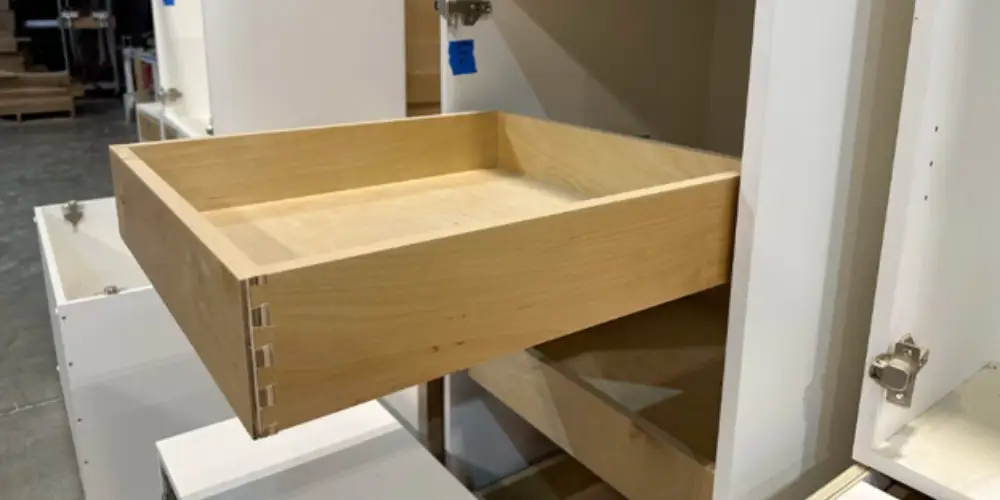
● Hardwood dovetail drawers
● Birch plywood drawers
● White melamine drawers
● Metal-sided drawer systems
● Slim metal drawer systems
● Custom-sized drawer boxes
A specialized manufacturer can give cabinet shops access to several construction options without requiring the shop to maintain separate production processes for each one.
This can make it easier to customize drawer specifications for different cabinet lines and projects.
Reducing Equipment and Labor Requirements
Producing drawer boxes internally means dedicating equipment, floor space, labor, and maintenance to that part of the manufacturing process.
For some cabinet shops, this makes sense. For others, outsourcing may be more efficient.
Instead of purchasing additional machinery or assigning employees to repetitive drawer production, the shop can use its existing resources for cabinet components, finishing, assembly, and other higher-value work.
The decision ultimately depends on production volume and the shop’s existing capabilities.
Scaling Without Expanding the Shop
Growth can create an interesting challenge for cabinet manufacturers.
Winning more projects is positive, but increasing production does not always mean a company can immediately expand its facility, purchase new equipment, and hire additional workers.
Outsourcing can provide additional production capacity without requiring the same level of investment in infrastructure.
This can be particularly useful for cabinet shops handling larger residential projects, multi-unit developments, closet programs, or recurring orders.
Customization Is Still Possible
Outsourcing does not necessarily mean using standardized products.
Professional B2B manufacturers can produce drawer boxes according to project-specific requirements, including dimensions, materials, construction methods, and hardware specifications.
For cabinet shops, this means they can maintain control over the design while allowing a specialist to handle the drawer production.
When Does Outsourcing Make Sense?
Outsourcing may make sense when a cabinet shop:
● Has limited production capacity
● Needs large quantities of drawer boxes
● Wants to reduce repetitive shop labor
● Does not own specialized drawer-making equipment
● Needs multiple drawer construction options
● Wants more predictable production
● Is experiencing increased project volume
For a shop with low drawer volume and the right equipment already in place, in-house production may still be the better choice.
The decision should be based on the total cost of production not simply the price of purchasing a finished drawer box.
The Bigger Picture
Outsourcing drawer production is not necessarily about doing less manufacturing. It is about deciding which parts of manufacturing should happen inside the shop and which can be handled more efficiently by a specialist.
As cabinet and closet businesses become more focused on customization, precision, and production efficiency, specialized drawer box manufacturing can become a valuable part of the supply chain.
The cabinet shop remains responsible for the overall design and finished product, while a specialized manufacturing partner can handle one of the most repetitive and specification-sensitive components.
For growing cabinet shops, that division of production can create more capacity, greater consistency, and more flexibility without requiring every manufacturing process to happen under the same roof.