
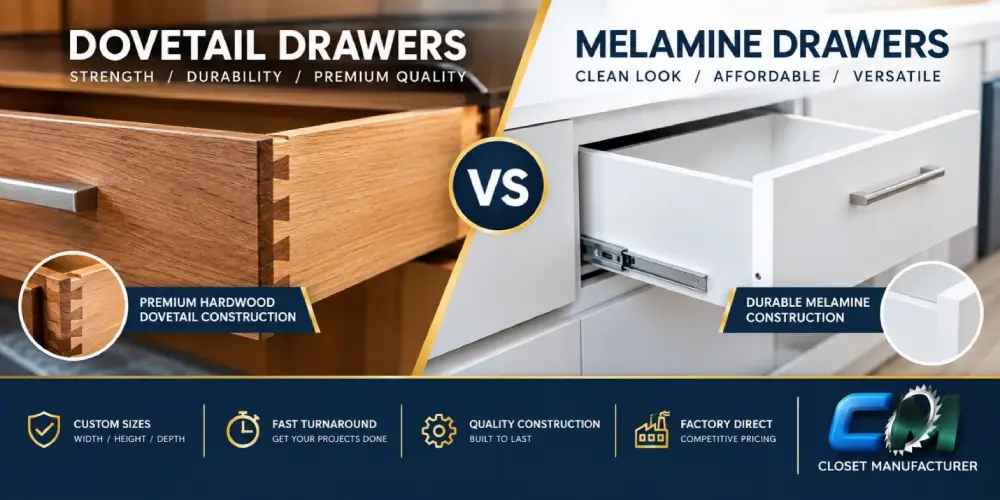
Drawer boxes are an important part of cabinet and closet production.
While the drawer may appear to be a simple component, its material, construction, dimensions, and hardware all affect the finished result.
Cabinet shops have several options when selecting drawer boxes. The choices are hardwood dovetail drawer boxes and melamine drawer boxes.
The right solution depends on the type of project, desired appearance, and customer choice.
What Are Dovetail Drawer Boxes?
Dovetail drawer boxes use an interlocking joinery method to connect the drawer components.
The sides, front, and back are machined with pins and tails that fit together. This creates a mechanical connection at the corners and gives the drawer a traditional look.
Dovetail is often selected for jobs where the drawer box is an important part of the overall look and durability required.
For example, kitchens have heavy pots and pans that require more durable drawers as opposed to closets that just have socks and garments.
Common uses for dovetails are: Kitchen drawers in modern homes or Cabins. Furniture Wardrobe cabinets.
The final performance of a dovetail drawer still depends on precise manufacturing, exact dimensions, hardware, and professional installation.
What Are Melamine Drawer Boxes?
Melamine drawer boxes use melamine-faced board to create the drawer components.
The material provides a finished surface that is available in different colors, textures, and finishes. It also provides a surface that is relatively easy to clean and maintain.
Melamine can be a practical option for projects where consistent production and a finished drawer interior are important.
It is commonly considered for: basic closets and large volume projects like commercial offices and medical offices.
For cabinet shops producing multiple drawer boxes, manufactured melamine components can also provide consistent sizing across a production run.
Dovetail vs Melamine: What Is the Difference?
The main difference between the two options is the combination of material and construction.
Dovetail vs Melamine Drawers involve different materials, joinery methods, appearance, production requirements, and costs.
Dovetail drawer boxes are generally associated with hardwood construction and interlocking joinery. Melamine drawer boxes use melamine-faced board and provide a consistent finished surface.
When comparing the two, cabinet shops should consider:
• Material
• Joinery
• Appearance
• Durability requirements
• Weight
• Cost
• Production volume
• Maintenance
• Hardware compatibility
• Project specifications
Neither option is automatically the right choice for every project.
The better choice depends on what the cabinet shop needs to produce and what the finished project requires.
Material Selection Matters
The material used for a drawer box affects more than its appearance.
Hardwood, melamine, and plywood each provide different characteristics that can affect construction, weight, cost, and available interior space.
Plywood drawer boxes can also be considered when a project requires a different balance of weight, dimensional stability, and material characteristics.
Cabinet shops should specify the material and thickness before production begins.
Material thickness can affect:
• Interior drawer space
• Outside dimensions
• Slide clearance
• Joinery
• Drawer front attachment
• Cabinet opening requirements
Changing the material without accounting for these dimensions can create fitting issues during assembly or installation.
Drawer Dimensions and Hardware Must Match
The drawer box and drawer slide should be considered together.
The finished drawer needs to fit the cabinet opening while providing the correct clearance for the selected hardware.
Before ordering drawer boxes, cabinet shops should confirm:
• Drawer box width
• Drawer depth
• Drawer height
• Material thickness
• Inside dimensions
• Drawer slide type
• Required slide clearance
• Bottom construction
• Drawer front attachment
This is particularly important when drawer boxes are manufactured by an outside supplier.
Providing complete specifications before production can help reduce modifications and prevent avoidable installation problems.
Which Drawer Box Is Right for Your Project?
The right drawer construction depends on the application.
Dovetail drawer boxes may be a good fit when:
• Hardwood construction is required
• Traditional joinery is part of the specification
• The project is higher-end
• Drawer appearance is important
• A furniture-style drawer is desired
Melamine drawer boxes may be a good fit when:
• A finished drawer interior is preferred
• Consistent production is important
• Multiple drawer boxes are required
• Easy cleaning is a priority
• Material efficiency is important
• The project involves closets or production cabinetry
Production volume should also be considered.
A cabinet shop producing a small number of specialty drawers may have different requirements from a manufacturer producing hundreds of identical boxes.
What Cabinet Shops Should Specify Before Ordering
Clear specifications are important for consistent drawer box manufacturing.
Before placing an order, cabinet shops should provide:
• Material: Hardwood, melamine, plywood, or another specified material
• Construction: Dovetail or another required joinery method
• Dimensions: Exact width, depth, and height
• Thickness: Required material thickness
• Drawer Slides: Hardware and clearance requirements
• Quantity: Number of boxes required for each size
• Finish: Color and surface requirements
• Drawer Front: Mounting and alignment requirements
• Custom Details: Notches, drilling, special sizing, or other requirements
A detailed cut list, drawing, or production file can make these requirements easier to communicate.
This becomes especially useful for B2B orders involving multiple drawer sizes or large cabinet runs.
Why Manufacturing Consistency Matters
For cabinet shops, producing one correctly sized drawer box is only part of the process.
The larger challenge is producing dozens or hundreds of boxes that all match.
Consistency matters for:
• Cabinet assembly
• Drawer slide installation
• Drawer front alignment
• Project scheduling
• Installation
• Repeat orders
A specialized drawer box manufacturer can focus specifically on repeatable production.
This allows cabinet shops to spend more time on cabinet fabrication, finishing, assembly, and installation instead of dedicating the same resources to repetitive drawer production.
Custom Drawer Boxes Are Still an Option
Outsourcing drawer box production does not necessarily mean using standard sizes.
Cabinet shops and closet manufacturers may require drawer boxes with specific dimensions, materials, construction methods, or hardware requirements.
Custom manufacturing allows the drawer box to be produced according to the cabinet specification.
This can be useful for:
• Custom cabinet projects
• Closet systems
• Large production runs
• Multifamily projects
• Commercial cabinetry
• Projects with multiple drawer configurations
The cabinet shop can maintain control over the overall cabinet design while having the drawer boxes produced according to the required specifications.
When Should You Choose Dovetail or Melamine?
The decision should start with the requirements of the project.
Dovetail construction may make more sense when hardwood, traditional joinery, and furniture-style construction are important.
Melamine may make more sense when a finished surface, repeatable production, easy maintenance, and material efficiency are higher priorities.
Cost should also be considered, but it should not be the only factor.
The purchase price of a drawer box is only one part of the total production cost. Cabinet shops should also consider labor, equipment, material handling, production time, and installation.
The most practical option is the one that fits the complete production process.
The Bigger Picture
Choosing between dovetail and melamine drawer boxes is ultimately a matter of matching the drawer construction to the project.
Dovetail drawer boxes can provide a traditional hardwood solution for projects where construction and appearance are important.
Melamine drawer boxes can provide a finished, consistent option for applications where production efficiency, maintenance, and repeatability are priorities.
For cabinet shops, the most important step is making sure the material, dimensions, construction, hardware, quantity, and custom requirements are clearly defined before production begins.
Closet Manufacturer produces custom drawer boxes for professional cabinet and closet applications, with options for different materials, sizes, and construction requirements.
If you are preparing a cabinet or closet project, providing your drawings, dimensions, or specifications can help determine the drawer box construction that fits the job.
FAQs
Dovetail drawer boxes typically use hardwood and interlocking dovetail joinery, while melamine drawer boxes use melamine-faced board to provide a consistent finished surface.
Dovetail construction creates an interlocking mechanical joint and is commonly used for hardwood drawer boxes. Overall drawer performance also depends on the material, dimensions, manufacturing accuracy, hardware, and installation.
Maple and other hardwoods are commonly used for dovetail drawer boxes.
Melamine can be a practical option for closet systems because it provides a finished surface and can be manufactured consistently across multiple drawer sizes.
Yes. Drawer boxes can be manufactured to specific width, depth, height, material, construction, and hardware requirements.
The drawer box and slide need to work together to provide the correct clearance and operation within the cabinet opening.
Cabinet shops should provide the material, construction method, dimensions, thickness, drawer slide requirements, quantity, finish, drawer front requirements, and any custom details.