

A drawer box stays out of sight until it is opened, yet it is part of daily life in every kitchen. From flatware to cookware, drawers hold the items people reach for most, so the way they are built shapes how they perform for years. Joinery, material, dimensions, and hardware all play a part.
This guide explains what a dovetail drawer is, how the joint works, and the main benefits of dovetail drawers for kitchen cabinets.
What are the benefits of dovetail drawers?
A dovetail drawer is a drawer box whose edges are linked with interlocking angled cuts called pins and tails. The pins on one board match the tails on the other like a puzzle piece. This form mechanically binds the pieces together, increasing strength beyond glue or fasteners. It is one of the oldest and most recognizable joinery techniques in woodworking.
1. Strong Joints for Everyday Use
When you pull open a loaded drawer, the force pulls the drawer front away from the sides. The angled shape of a dovetail joint keeps the pieces locked together against that force. Kitchen drawers often hold items such as cast iron cookware, mixing bowls, and small appliances, and the corners carry much of that load. Interlocking joints help the box stay tight and square over time.
2. Durability Comes From the Whole Build
Joinery is a key factor, and a drawer performs best when it is paired with well-chosen materials and hardware. These factors all contribute:
- Wood species: Hardness and grain influence wear, screw holding, and how the wood takes a finish.
- Stock thickness: Thicker sides add stiffness for heavier loads.
- Machining accuracy: Tight, even joints come from clean, repeatable cuts.
- Assembly quality: A square box keeps drawer slides running smoothly.
- Slide compatibility: Box size and load rating are matched to the hardware.
When these elements work together, the drawer supports long-term performance.
3. Craftsmanship That Suits Custom Kitchens
Dovetail corners are visible whenever the drawer is open, and they look especially attractive under a natural wood finish. In custom kitchen cabinets in Pompano Beach, dovetail joinery complements traditional, transitional, and contemporary styles. The clean lines add visual interest without added decoration, and they bring the same level of care to the drawer interior as to the doors and face frames.
4. Where Dovetail Drawers Are Commonly Used
Dovetail drawers are common in custom and high-end kitchens where quality of craftsmanship is part of the design. This construction can be customized for each project based on drawer use, wood species and finish desired, project budget, and overall cabinet style.
5. Consistent Construction Supports Smooth Installation
Accurate dimensions are just as valuable as the joint itself. When drawer boxes are made to consistent sizes, cabinet assembly is faster, slide alignment is more precise, and installation is more predictable, especially in kitchens with many drawers. These are the details commonly reviewed when evaluating a drawer box:
- Joint precision: Pins and tails fit neatly and evenly.
- Material selection: Wood species, thickness, and finish match the specification.
- Dimensional accuracy: Measurements and tolerances are clearly defined.
- Hardware compatibility: Box dimensions match the chosen drawer slides.
- Order consistency: Drawer boxes in the same set share the same dimensions and construction.
Conclusion
Dovetail drawers combine secure corner joinery with the look of traditional woodworking. Along with the joint, the wood species, dimensions, hardware, and consistent manufacturing all contribute to how well a drawer performs. Understanding these factors makes it easier to plan drawer construction for a kitchen project.
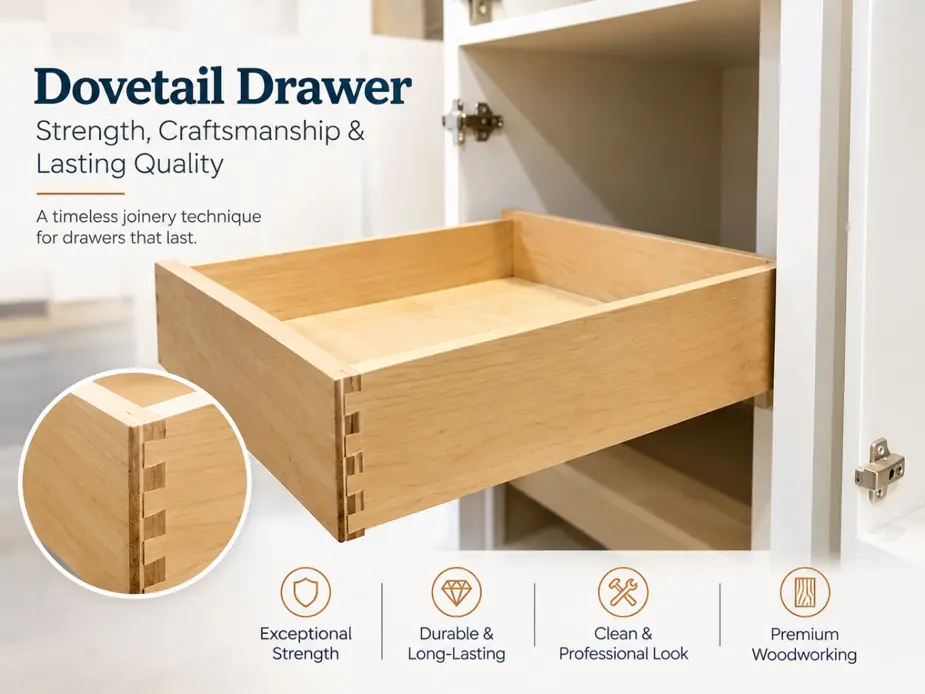
Benefits of Dovetail Drawers
FAQs
The angled pins and tails lock together, which helps the drawer front stay securely attached to the sides when a loaded drawer is opened.
Joinery, wood species, stock thickness, machining accuracy, and slide compatibility all work together to support long-term performance.
Yes. The clean, interlocking corners complement traditional, transitional, and contemporary cabinetry, especially under a natural wood finish.
Joint precision, material selection, dimensional accuracy, and hardware compatibility are the main details to review.
Yes. Drawer boxes can be manufactured to specific width, depth, height, material, construction, and hardware requirements.
They are common in custom and high-end kitchens, where construction quality and finish are priorities. The final choice can be tailored to drawer use, material preferences, budget, and the desired finish.